

The decision that shapes your EU supply chain
You have decided to store goods under customs bond in Europe. The financial case is clear: deferred duties, suspended VAT, batch clearance aligned to sales. But the logistics partner you choose to operate that bond will define whether the model works or whether it becomes a compliance headache with hidden costs.
For companies based outside the EU — the US, UK, China, India, Turkey, the Middle East — selecting a bonded warehouse partner in the Benelux or Western Europe is one of the most consequential supply chain decisions you will make. Get it right, and you have a frictionless route into 450 million consumers. Get it wrong, and you are managing customs delays, split stock, and margin erosion from day one.
This is what to look for.
1. Customs warehouse authorisation — not just warehouse space
Any warehouse can store pallets. A bonded warehouse must hold a valid customs warehousing authorisation under the Union Customs Code (UCC), granted by the national customs authority. In Belgium, that is the General Administration of Customs and Excise. In the Netherlands, it is the Douane.
Ask your potential partner: do you hold the customs warehouse authorisation yourself, or are you subletting space inside someone else’s bond?
The distinction matters. An operator that holds its own authorisation manages the customs stock records, controls the bond, and carries the financial guarantee. A subletter depends on someone else’s compliance infrastructure — and that adds a layer of risk and delay to every release.
Middlegate holds its own bonded warehousing authorisation at Zeebrugge, within the Port of Antwerp-Bruges. The bond, the stock records, and the customs declarations are all under one roof.
2. In-house customs clearance
Bonded warehousing without customs capability is storage without a steering wheel. Every release from bond — whether into free circulation, re-export, or transit — requires a customs declaration. If your warehouse partner outsources that to a third-party broker, you have introduced a delay and a cost on every order.
Look for a partner that clears customs in-house. That means they lodge the declarations, calculate the duties, and manage the fiscal interface with customs authorities — directly from the warehouse floor.
This is how batch clearance becomes practical. Instead of declaring an entire container at once, you release stock per order, per customer, or per destination. Duties and VAT are paid only on what actually leaves the bond. But that only works efficiently when the warehouse and customs teams operate as one.
3. Location relative to deep-sea ports
For non-EU importers shipping containers into Europe, the distance between port and warehouse is a direct cost variable. Every extra kilometre between quayside and bonded storage adds drayage cost, transit time, and handling risk.
The Benelux sits at the centre of Europe’s logistics infrastructure. The Port of Antwerp-Bruges handles over 290 million tonnes of cargo annually. Rotterdam is the largest port in Europe. Together with Zeebrugge, they form a corridor that gives access to Germany, France, the UK, and Scandinavia within 24 to 48 hours by road.
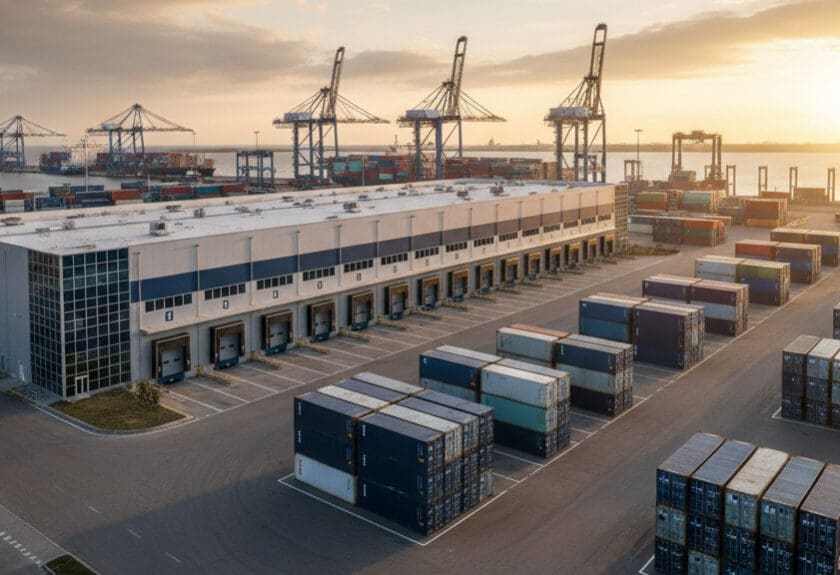
Middlegate’s bonded warehouse is at Zeebrugge, inside the port zone. Containers come off the vessel and move directly into bonded storage — no long-haul trucking, no intermediate handling. For UK-destined re-export flows, Zeebrugge offers daily RoRo sailings to Hull, where Middlegate operates a second warehouse.
4. Asset-based operation vs. brokered logistics
This is the question most importers do not think to ask: does the 3PL own its own warehouses and fleet, or does it broker capacity from subcontractors?
An asset-based 3PL controls the space, the staff, the trucks, and the customs licences. That means direct accountability. When a container arrives at 06:00, it gets unloaded by the partner’s own team, stored in the partner’s own racking, and cleared through customs by the partner’s own declarants. There is no coordination lag between three separate companies.
A brokered model — where a freight forwarder or digital platform stitches together warehouse capacity from one provider, customs from another, and transport from a third — introduces handoffs. Each handoff is a potential failure point: delays, data mismatches, unclear accountability when something goes wrong.
Middlegate runs 120+ tractors, 220+ trailers, and over 42,000 square metres of warehouse space across Zeebrugge, Liège, and Hull. Own metal. Own warehouses. Own customs team. One operator end to end.
5. Re-export capability for non-EU destinations
Many companies entering Europe do not sell exclusively within the EU. A significant share of goods may be forwarded to the UK, Switzerland, Norway, or other non-EU markets.
If those goods are stored under bond and re-exported, no EU import duties or VAT are ever charged. The goods leave under an export or transit procedure, and the fiscal obligation is zero. This is one of the most powerful financial advantages of bonded warehousing — but only if your partner can execute the re-export flow cleanly.
Ask whether the partner handles T1 transit documentation, export declarations, and cross-Channel or cross-border flows. At Middlegate, EU-to-UK re-export is a core service. The Zeebrugge–Hull corridor runs daily, with customs handled on both sides.
6. One stock truth across bonded and free-circulation inventory
Many importers store goods under bond and in free circulation simultaneously — for example, keeping bulk inventory under bond while maintaining a cleared buffer stock for fast EU dispatch. That creates two inventory pools with different customs statuses, different duty obligations, and different release procedures.
Your warehouse partner should be able to manage both pools from a single facility, with a single WMS, giving you a single stock truth. If bonded and free-circulation stock are in different warehouses or different systems, visibility drops and errors multiply.
7. Financial guarantees and compliance track record
Operating a bonded warehouse requires a financial guarantee to customs authorities — a bank guarantee or cash deposit that covers the potential duty liability on goods under bond. The size of the guarantee reflects the value and volume of goods stored.
Ask your potential partner about the capacity of their guarantee. A small guarantee limits how much stock can be held under bond at any given time. If you are importing at scale — high-value consumer goods, electronics, industrial components — the guarantee ceiling matters.
Also look at the compliance history. Does the partner hold AEO (Authorised Economic Operator) status? AEO certification signals that customs authorities have audited the operator and confirmed reliable systems, solvency, and security. It also enables access to simplified procedures and reduced inspection rates.
8. Scalability without long-term lock-in
Launching into a new market means uncertainty. Volumes may ramp slowly or spike unexpectedly. Your warehouse partner should offer flexible capacity — the ability to scale up space and services without requiring a five-year lease commitment before you have proven the market.
Look for pallet-in/pallet-out pricing, shared-user warehousing, and contracts that scale with your business. This is particularly important for non-EU companies testing the European market for the first time. You want operational commitment, not financial exposure on dead space.
9. Fiscal representation for companies without EU establishment
Non-EU companies importing into the EU often need a fiscal representative — an EU-established entity that assumes VAT obligations on behalf of the importer. Without this, the import declaration cannot be lodged, and goods cannot be cleared into free circulation.
Some bonded warehouse providers can arrange fiscal representation as part of the service. Others leave you to find it yourself. The more your partner can handle under one roof — warehousing, customs, fiscal representation, transport — the fewer moving parts you need to manage from overseas.
10. Communication and reporting that works across time zones
If you are managing European inventory from the US West Coast, Singapore, or Dubai, you are operating across significant time zone gaps. Your warehouse partner needs to provide clear, proactive reporting — stock levels, customs status, duty exposure, inbound and outbound movements — without requiring you to chase updates during European business hours.
A good partner keeps you informed. A great partner gives you a single point of contact who understands your flow end to end and can make decisions on your behalf within agreed parameters.
The checklist, summarised
Before signing with a European bonded warehouse 3PL, confirm these:
Customs authorisation: Does the partner hold its own bonded warehouse licence under the UCC?
In-house customs: Are customs declarations handled internally, or outsourced?
Port proximity: How far is the warehouse from the deep-sea port where your containers arrive?
Asset-based model: Does the partner own its warehouses, fleet, and customs team?
Re-export flows: Can the partner handle duty-free re-export to UK, EFTA, and other non-EU markets?
Dual stock management: Can bonded and free-circulation inventory be managed from one facility?
Guarantee capacity: Is the customs guarantee large enough for your projected stock value?
AEO status: Is the operator certified by customs authorities?
Flexible contracts: Can you scale without long-term lock-in?
Fiscal representation: Can the partner arrange EU fiscal representation for non-EU importers?
Reporting and access: Will you get proactive visibility from overseas?
Bonded warehousing at Zeebrugge, by Middlegate
Middlegate Europe operates bonded and free-circulation warehousing at Zeebrugge, inside the Port of Antwerp-Bruges. Customs clearance, transport, and re-export to the UK are handled in-house by the same team that manages your stock.
We work with importers from the US, UK, Asia, the Middle East, and across Europe. One partner. One flow. One stock truth — from quayside to customer delivery.
Looking for a bonded warehouse partner in Europe? Request a quote or speak with our team.
Need warehousing or logistics support?
Get a tailored quote for bonded warehousing, fulfilment, or transport from our Zeebrugge hub.
Request a Quote



 English